Kelly Kelleher's entrapment and drowning
Black Water (Joyce Carol Oates Edition)Kelly Kelleher's entrapment and drowning are the novel's central ordeal of bodily confinement and failing time: after The Senator's rented Toyota plunges into Indian Creek, Kelly is trapped in the submerged car, fighting for breath and trying to guide her would-be rescuer. The Senator escapes and later dives back, but reaches her too late. The final passage interweaves her death with an imagined emergence into the night and a childhood vision of her parents, making the gap between rescue and irreversible loss the scene's decisive fact.
Causes and Setting
On the evening of the Fourth of July, The Senator drives Kelly away from a party in a rented Toyota. He takes Old Ferry Road, a badly rutted route no longer used since a new paved road replaced it. The old road has no sign and should have been shut down; the mistake is understandable at dusk, but its condition makes the drive dangerous. The Senator is not lost in the simple sense: he is heading toward Brockden's Landing, but on a disused route.
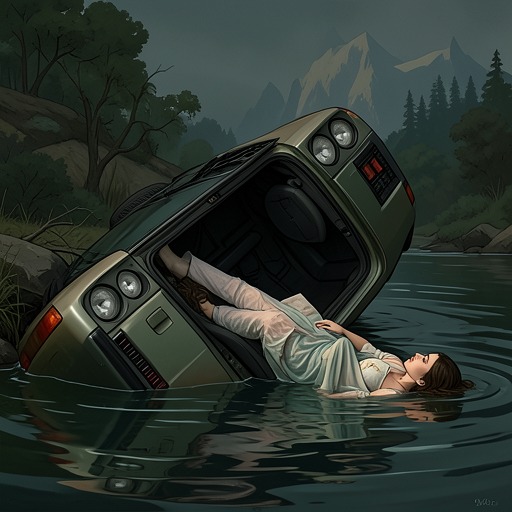
The car takes the turns in skidding slides. Its speedometer rises past forty miles per hour when it hits a sandy rut and begins to skid; later, the account speculates that the crash occurred at about forty-five miles per hour. The car breaks through the guardrail and plunges down an embankment into what first seems like a shallow pool. The water is Indian Creek, a marsh stream as deep as eleven feet in places, about twenty feet wide, and running toward the Atlantic near Brockden's Landing. The dark, marshy surroundings and the creek's depth turn what might appear a minor roadside mishap into a lethal submersion.
The Crash and Entrapment
The impact throws the car onto its passenger side. The guardrail breaks; rushes slap the windows, the glass cracks, and the passenger-side door and roof buckle inward. The water rushes over the hood and windshield as the car sinks rather than floats. Kelly's head strikes the window, and the vehicle's disorientation leaves her unable to tell where the top, the air, or even her own body is. Her right leg is pinned and her kneecap crushed, though shock leaves her without a clear sense of pain.
Kelly first fights against what she cannot identify as the car rocks and black water rises around her. Her left arm is tangled in a restraint; at other moments she claws at what holds her fast, tries to draw breath, and coughs and spits as water reaches her face. The scene makes survival depend on minute bodily adjustments. She grips the steering wheel and holds herself up, reasoning that if her mouth stays clear she can draw air from a small pocket inside the submerged vehicle.
The car does not fill all at once. Kelly understands that it retains one or more bubbles of air, but that water will seep through cracks and fissures and the remaining space will shrink. She has heard of people surviving for hours in submerged vehicles and tries to believe patience will bring rescue. Against that hope, she can feel and taste the filthy water, which she associates with sewage, gasoline, and oil. As the pocket of air dwindles, practical reasoning remains active even while darkness, injury, and fear make ordinary orientation harder to maintain.
The Senator's Escape and Return
At first, Kelly and The Senator struggle together in the submerged car. He groans and fumbles with his safety belt before forcing his way out through a door that lies above them because the vehicle has overturned. Kelly clutches his forearm and trousered leg, then grabs at his ankle and shoe as he pushes free. His crepe-soled canvas shoe comes off in her hand. Left behind, she begs him not to leave and believes he will return.
The narrative later explains that The Senator has escaped the doomed car and reached the shore, where he vomits up the filthy water. Exhausted, he stays away from the water he cannot bring himself to re-enter, then limps back across the marshland road with one shoe on and one off. His flight is shaped by fear for his own life and by the prospect of being discovered: he reaches a roadside telephone booth, calls Ray Annick, and says there has been an accident and that Kelly is dead. His claim is not an accurate account of the rescue still unfolding in Kelly's perceptions; it conveys his assumption and panic, not proof that she has already died.
Kelly, meanwhile, interprets his absence through trust. She remembers that he had not known what he was doing when he kicked free of her grip, understands his action as blind panic, and continues to believe he will save her. Later, she hears him in the shallows, calling her name and searching for her. He dives toward the car and reaches the cracked windshield; she sees his fingers spread against it. The return is real, but the rescue comes at the edge of her death.
A Shrinking World
Kelly tries to preserve air and communicate. She speaks her location into the darkness, repeatedly calling that she is there, and listens for The Senator moving above her. Her voice is not a scream of uncontrolled panic: she tries to speak clearly because she believes he must be able to hear and find her. Yet her ability to make sense of the space keeps narrowing. She can no longer name the area beyond the passenger seat, where her knees and feet had been, or hold onto the words for air and light.
The scene's sense of time is equally unstable. Kelly cannot tell how long she has been trapped, and the rising water and waning air seem to suspend the ordinary movement of time. A patch of moonlight becomes a simple test of life: if she can see it, she is still alive. Holding her mouth toward the remaining pocket of air and her head above the foul water takes tremulous physical effort, while coughs, choking, and the water itself repeatedly threaten the breath she is trying to conserve.
Her hope does not mean she misunderstands every danger. She knows the trapped air cannot last indefinitely and tries to bargain with the imagined rescue team, offering even her legs to be amputated if that is what escape requires. She also imagines taking blame herself. These thoughts give her a way to keep acting and negotiating when she has almost no physical control. The bargaining is set against the stark bodily fact of her crushed, pinned leg and the closing air pocket: she can imagine consenting to almost any cost, but cannot free herself.
Death and Imagined Rescue
When The Senator finally opens the door that trapped her, Kelly believes he has arrived in time. She sees him swimming down, feels his hands close around her wrists, and imagines being hauled upward together, suddenly weightless on the way to the surface. Then she slips free of his hands and swims for herself, her legs seeming restored. She uses the Australian crawl taught at school and rises toward the night air, relieved to see the moon again.
That apparent escape gives way to a vision of her parents waiting among the tall grasses. They appear old and grief-stricken, and seem not to recognize her as she imagines herself as the little girl who once ran toward them in white anklet socks, asking to be lifted. The childhood image does not undo the physical ending: as the black water fills her lungs, Kelly dies. The imagined ascent and the final submersion occupy the same ending, making the rescue she longs for both emotionally vivid and tragically impossible.
Narrative Significance
The account moves between the crash's external circumstances, The Senator's escape and desperate call, and Kelly's confined, repeatedly interrupted perceptions. The reader can know more than Kelly can—where the creek is, what has happened to the car, and that The Senator reached shore—while still experiencing the limited air, broken orientation, and uncertain time through her struggle. A rescue that occurs too late is therefore not merely a plot outcome: it is a collision between the outside sequence of events and the desperate hope that structures Kelly's remaining consciousness.
The contrast between the Fourth of July celebrations and the wreck sharpens that collision. Elsewhere on Grayling Island, people gather by the shore and await fireworks; for Kelly, moonlight is reduced to a small, precarious sign that she remains alive. The public night of spectacle continues while the submerged car becomes a private world of darkness, injury, and diminishing air. The creek's black water finally overwhelms not only Kelly's body but her ability to name her surroundings, even as memory and imagined reunion persist to the last.